PaxForex Free $200 No-Deposit Bonus

Dates: all year 2012
Bonus: $200 bonus - no deposit required. Valid for new clients only.

How to get: register a live account with PaxForex. The balance on the bonus account and on the standard account is only for trading during first month.

Other conditions: The client can transfer bonus profit to the trading account without deposit only after 1 month of registration and if the following conditions are met:
  • Profit on the bonus account is more than 200$.
  • 5 volume lots completed

Withdrawal: volume requirements apply.

How To Apply Instructions

Step 1
Click OPEN TRADING ACCOUNT


Step 2
Click GET BONUS


Step 3
Click GET BONUS


Step 4
On registration page choose BONUS "Be Online", Be Online, Get $200.


Then complete your registration, verify your account (Check your email).

Download MT4 and you're ready to making money with $200 No-Deposit Bonus.

Signup now..
Link: "Be Online" $200 no-deposit bonus from PaxForex

Read more »

Buy AUDUSD 4/4/2012

Buy AUDUSD @ 1.0186-0150.

Target: 1.0250 ++

Stop Loss: -


Good Luck and Happy Trading!

Read more »

Buy EURUSD 4/4/2012

Buy EURUSD @ 1.3130-3100.

Target: 1.3200 ++

Stop Loss: -


Good Luck and Happy Trading!

Read more »

Sell EURUSD 27/3/2012

Sell EURUSD @ 1.3348-3363.

Target 1: 1.3305
Target 2: 1.3260

Stop Loss: 1.3380


Good Luck and Happy Trading!

Read more »

GG-RSI-CCI Indicator

Name: GG-RSI-CCI
Download: GG-RSI-CCI.mq4 (3.5 Kb)

Description:

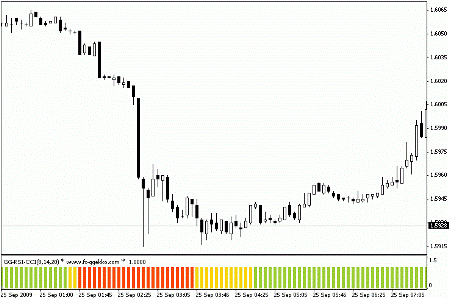
This indicator informs you about the trend and offers a good entry possibility. Not useful for exit signal.

Ind_Period: period of the indicators (RSI and CCI).
Avg_Period1 and Avg_Period2: periods of the moving averages of the indicators.


Source: Mql4.com

Read more »

GG-TimeBox Indicator

Name: GG-TimeBox
Download: GG-TimeBox.mq4 (5.0 Kb)

Description:

Timeframe indicator. Customizable timeboxes on any chart.

Some examples:


Source: Mql4.com

Read more »

Signal Length Indicator

Name: Signal Length
Download: signallength_eng.mq4 (7.8 Kb)

Description:

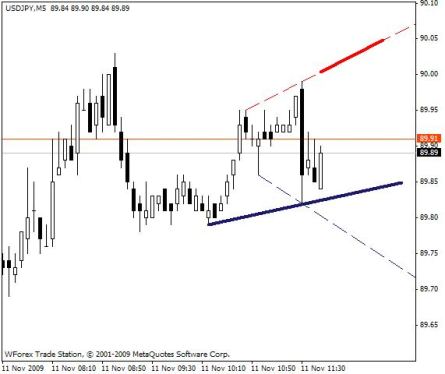
When the price is approaching to the Signal Lines, the indicator sends Alert. The Signal Lines can have any angle.

Initially, the Signal Lines are based on the straight lines of the support and resistance levels. Signal Lines can be moved to the desired place using the mouse .

When the distance between the Bid and Signal Lines is lower than specified (in points), the indicator sends Alert, with the name of the crossed signal line.

If the variable remove_segments is defined, it draw a new segments after the period change. The total number of Signal Lines is not limited.

To use the indicator copy it to the folder "C: \ Program Files \-Terminal-\ experts \ indicators" and attach to the chart.


Source: Mql4.com

Read more »

Two Pole Smoothed Oscillator Indicator

Name: Two Pole Smoothed Oscillator
Download:
Ehlers Two Pole Super Smoother Filter.mq4 (2.7 Kb)
Ehlers CyberCycle.mq4 (2.7 Kb)
Ehlers CG.mq4 (2.6 Kb)
Ehlers Super Smoother Smoothed oscillator.mq4 (2.1 Kb)

Description:

The Two Pole Super Smoother Indicator is a great way to evaluate the trend, and a good alternative the a regular moving average. But it can hardly be used tofind the turning points of the major cycles.

So I've transformed the Super Smoother Indicator as a smoothed oscillator.

The oscillator accurately find most of the cycle's turning points, while the additional smoothing removed the residual noise.

In order to remove the residual noise from the oscillator, I used Ehlers' Instantaneous trendline filter, because this filtershows a great noise reduction capacity while keeping the additional lag really low.

because all the Maths have been modified in order to be based on the Open prices, the indicator won't retrace.

Lag:

Please note that the original Two pole Super Smoother indicator presents a small lag proportional to it's Cutoff Period. Because the version on this page has been modified to be based on the Open price (in order to avoid retracements), one bar of lag is added.

Finally, the Instantaneous trendline filter is adding a little lag too, which should not be of more than 2 bars.

As a result, you should not use this indicator in order to catch cycles with a period of less than 10 bars.

If you want to catch 5 bars cycles on H1 for example, you can use this indicator on the M1 or M5 timeframe, using a large cutOff period. The additional data available on small timeframes allows you to trade short cycles.


Recommendations:
  • This indicator can be pretty accurate, but is not magic. Please confirm the signals using other indicators (preferably DSP indicators).
  • Ehlers' CyberCycle is a great indicator to filter the signals. Uses the same alpha in both indicators.
  • Ehlers' CG (Center of gravity) is also a great indicator to filter the signals. Uses CG's period = Oscillator's CutOff/2.
  • Filtering the signals using an adaptive indicator (like Adaptive CyberCycle or Adaptive CG) seems to be a great idea, but the fact is that an adaptive indicator won't be synchronized with this indicator and can lead to more noises in the signals.
  • This indicator is best adapted to detect 30 bars or higher cycles. Its accuracy drops when used to detect short cycles.

Source: Mql4.com

Read more »

LineMA Indicator

Name: LineMA
Download: LineMA.mq4 (3.7 Kb)

Description:

Its another averaging of moving averages. If shows green line, if buy signal only and red line in case of sell signal only.

Nothing new, just more clearly.


Source: Mql4.com

Read more »

Oil - Signs That a War in Iran is Close

The clock is ticking closer to the midnight hour regarding a strike in Iran. Israel might do it alone, but will likely have the backing of the US.


Is a war imminent, or are these moves just meant to scare Iran? Here are 5 signs that have piled up very recently.

SWIFT Cuts Iran Off: The international institution responsible for around 80% of the world’s financial transactions announced that it will cut off Iranian financial institutions from its system from Saturday.  This unprecedented move is a big blow to Iran, and follows up on EU sanctions.

Majority in Israeli cabinet for strike: Israeli newspaper Maariv (Hebrew link, quote in English) by Ben Caspit saying that 8 out of 14 Israeli cabinet members now support a strike on Iran’s nuclear facilities. The cabinet can give Prime Minister Netanyahu the green light for a strike, at the time he sees fit.

Netanyahu preparing Israeli public: The Israeli Prime Minister continues the tough rhetoric against Iran also after coming back from his long visit in the US. Analysts see this as a preparation of the Israeli public for a war.

Using Oil Reserves: There was a report, later denied, that the US and the UK decided on releasing oil from the emergency reserves in order to lower prices. This could be another preparation.

“Last Chance” Warning: According to Russian sources, US Secretary of State Hillary Clinton asked the Russians to send a message to Iran that the upcoming talks 6 nation talks with Iran are the last chance before military action.

Needless to say, oil prices certainly play a role in the considerations of all sides. Iran is the world’s 5th largest producer of oil, and sits on the Straights of Hormuz, where 40% of the world’s shipments pass through.

All these moves could mount to a preparation for a US backed Israeli strike against Iran’s nuclear facilities. It could also just add to pressure against Iran, trying to force it to comply without really engaging in military action.

Source: ForexCrunch.com

Further reading:

Read more »

How will Currencies React If Israel Attack Iran

On November 8th, The International Atomic Energy Agency(IAEA) is due to publish an updated report about Iran’s nuclear program. It is expected to provide new and worrying details about Iran’s nuclear capabilities. Towards this event, news about an upcoming Israeli attack on Iran have emerged.


The chances of an airstrike to happen are low. 5 reasons are detailed below. But if tensions rise, how will this impact currencies?

Why a strike has low chances:

Israeli threats add to pressure on sanctions: The Western countries will want to increase sanctions on Iran, while Russia and China are reluctant to do so. Raising the threat to attack puts pressure for more sanctions and helps the US and its allies.

Israeli government under internal pressure: The J14 social justice movement continues to be very active. The government led by Netanyahu managed to divert attention from the recent protest on October 29th through a mini-escalation in Gaza. Keeping Iran in the headlines also helps move public attention to external enemies and diverts attention from internal economic issues. Also the release of abducted soldier Gilad Shalit has a lot to do with this internal pressure. But will the government go ahead with a strike? Probably not – polls show that only half of the population supports an attack, and that most Israelis are convinced it will trigger a full scale conflict. So it’s better to keep the media busy with threats, but to avoid acting.

No US Approval for an Israeli strike: It is hard to believe that Israel will act on its own in attacking Iran. In the past, the different US administration gave Israel a clear red light regarding such an attack. The US may express concern about Israel doing it on its own, but it also goes to show that there is no US approval. In addition, it is uncertain if a full scale destruction of the Iranian nuclear plans can happen without military assistance from the US.

The US doesn’t need another war: The US economy is still in dire straits, despite some encouraging signs seen lately. Obama just announced a retreat from Iraq. Allocating resources to the same region once again will strain the US budget, just as the super committee is trying to find ways to reduce the deficit, and isn’t having a lot of success. Another war, even if the US participation is limited, will put a lot of pressure on US finances one year before the elections, and when the US is finally showing some signs of recovery.

Iran also prefers to focus on external enemies: The Arab spring has also reached the Islamic Republic. Protests were crushed also in Teheran a few months ago. But now there are tensions within the ruling elite that have been surfacing. Keeping tension high with the US and Israel means less awareness of internal issues. The Iranians certainly want tension and it recently said that they will cause “1 million Israeli casualties with only 4 missiles”. But a full escalation isn’t desired also in Tehran.

In case that tensions continue to mount and of course in case all these assumptions collapse and a strike is carried out, most winners and losers can be clearly marked:
  • The US dollar and Japanese yen will jump as safe haven currencies: they are the clear safe havens at the moment.
  • Euro, pound, Aussie, kiwi to crash: these are the clear risk currencies at the moment. The mess in Greece and now in Italy already weighs heavily on the euro and has a strong impact on the others.
  • The Canadian dollar will drop: While Canada exports oil which will clearly rise in case of a Middle Eastern conflict, the Canadian dollar tends to behave more like a risk currency.
  • The Swiss franc will swing: uncertainty is lower regarding the franc: on one hand, it has moved to the camp of risk currencies since the huge SNB intervention. But on the other hand, it could switch back to the “safe haven” camp in case of a conflict in the Middle East. This is what happened when the Libyan civil war broke out.

What do you think can happen?

Read more »

EURUSD Head and Shoulders Forming

EURUSD daily chart head and shoulders pattern in the making.

A head and shoulders pattern looks like a human head with 2 shoulders on either side. The shoulders are lower than the head and are often of equal height to each other. The blue line extending horizontally across is the neckline, which connects the 2 low points.


This is a top reversal pattern, or a bearish signal. Of course, this trade setup is still in the making and is only confirmed if prices follow the direction of the red arrow, breaking below the neckline. The pattern is however void once prices break the high of 1.3484.

You can expect many traders to go short if prices break below the neckline level of around 1.3017.

Source: AsiaPacFinance.com

Read more »